Thursday, August 16, 2012

Wk 3 - The Art of Possibility - Ch. 5-8

Ram Das - Be Here Now
Lama Foundation - New Mexico - 1971
from wikipedia.org


The more I read The Art of Possibility, the more it reminds me of Ram Das' 1971 spiritual guidance book "Be Here Now." This is especially true for Chapter 7, "The Way Things Are" which implores us to accept the world as it is now, in all its splendor and glory, with all its imperfections and human flaws. Chapter 7 is really about the practice of mindfulness - being present in the moment with out the "calculating self" getting in the way of possibility.  Be Here Now - Here Now Be - Now Be Here.

Reading Chapter 5, "Leading From Any Chair" made me think about the many times that my students taught me something, or led the class into a deep conversation that I had not planned.  Many times in our Wimba sessions we each take our turn leading and moving the conversations forward.  If we all remember that all humans are of equal worth, then the dichotomy between teacher and student begins to break down and unforeseen possibilities will arise.

Chapter 6 is my favorite chapter in the book so far.  The wonderful "Rule #6: Don't take yourself so goddamn seriously" is such a great piece of advice.  If it is true that "all is invented," then that includes the invented way in which we view our own selves.  If we are honest with our selves, we would see that on the grand scale of the Universe, our individual lives are meaningless and insignificant.  However, the same honesty can reveal that on a human life scale, each individual life is meaningful and full of possibilities.  We just need to "lighten up" to see these truths.

Finally, Chapter 8 implores us to give into our passions.  Allow the energy of your passions to guide your path through the Universe of possibilities.  Open your heart and allow the Universe to sing in the uniqueness of your inner voice.


Friday, August 10, 2012

Wk 2 Response to Michael Brosnan's Blog Entry

Original Post - Michael Brosnan

The Art of Possibility

This is an interesting book stocked with stories and commentary surrounding attitudes towards productivity and contribution. In the first couple chapters I felt more as if it were a self-help book than one that would actually apply to the EMDT program, but nevertheless, I read on. By the time I completed chapter four, I didn't want to stop reading! Although the book thus far is more about mindsets and attitudes than implementing technology or lesson designs, there is poignant commentary for not only educators, but all professionals.

"In the realm of possibility, we gain our knowledge by invention."(20) Of all the sentences in the first four chapters, this one resonated strongly with me. I'm going to make a poster of it for my classroom! I have always strived to make my classroom one of possibility, but in the past several years I've tried to really teach history slightly differently. History can be a little dry, so I restructured almost all of my units in sort of a "choose your own adventure" sort of way so that students can discover and consider various possibilities. We do a lot of hypothesizing and predicting now. Students have learned to consider a particular option and predict the ramifications of their decisions. One example in particular that comes to mind is the Reconstruction Period after the Civil War. Students had to compile a thorough reconstruction plan for the nation that included rebuilding the South, educating the freed men and women, creating jobs, reassuring the North of rebuilt southern allegiance, etc. The students were initially concerned that "they'd guess wrong" - that wasn't the point. Once they got over it, they realized that anything was possible in their plan if they could defend its purpose.

In what could have been a few day lecture of the actual reconstruction plans, students were allowed to invent their own solutions. At the conclusion of the unit, they were merely informed of what was actually done - many of their invented plans contained attributes of the actual reconstruction plans. Students gained a thorough knowledge of not only the historical reconstruction plans, but a deeper knowledge of what reconstruction of a broken nation might entail. I realized their depth of understanding when we later critiqued the Fourteen Points at the end of WWI.I think it is important for educators to create an environment of possibility for students to invent and explore. It is a decidedly American trait to innovate and create and that's what students should always have the opportunity to do. (Of course they need to copyright it though...)

My Response:

Hey Michael,

I would say that the Zander's book is a self-help book, and I too have found the book hard to put down.  What really intrigues me about your blog post is the description of how you have chosen to teach your students about the post-Civil War Reconstruction Period.  What a brilliant idea to have your students come up with their own reconstruction plan before showing them the actual Reconstruction plan.  History as taught by so many traditional teachers can be such a dry and boring subject.  It's so hard to get students to find the meaning of past historical events as they apply to the student's limited vision of the world at such a young age.  Surely one of the goals of learning History is to hopefully prevent past mistakes from re-occurring in modern times.  Of course, History is usually taught in such a boring manner, that the human race rarely learns the lessons of the past, and we sometimes seem doomed to repeat our mistakes forever and ever.  How many "wars to end all wars" have been waged in the past few hundred years?  Having your students invent their own reconstruction plans connects them to their past in an engaging way that helps them realize the significance of historical events.  When they realized that they did not need to come up with the original Reconstruction plan (guessing wrong was "OK")  the students were able to take ownership of the assignment and start thinking for themselves.  You have really come up with an excellent way to teach any subject.


Wk 2 Response to Angelo Pardo's Blog Post

Original Post - Angelo Pardo

Okay, I admit that I am not too thrilled with reading assignments, especially when they are directly related with education, design, or technology. It was actually quite refreshing to read “The Art of Possibility” by Benjamin and Rosamund Stone Zander.

I was immediately drawn into the reading when I read the line that ‘everything is invented’ in Chapter 1. The idea encouraged me to create my own game, with rules and limitations, and not play the games of others, especially those games that encouraged a mind of self-defeat. Chapter 2 explained the universe of possibility and how everything in the universe is in our grasp. Once we stop thinking in measurements and start thinking in possibilities, we unlock a great deal of opportunity and potential that has always been in front of us the whole time. Chapter 3, one of my favorite chapters, introduced the idea of ‘Giving the A’. When Benjamin decided that standards were a deterrent to learning and creativity, he awarded his students A’s at the beginning of his course, but only if they wrote a letter in the past tense stating how they deserved the grade. Giving the A puts everyone, whether student or teacher, father or daughter, in the same place of understanding, void of judgment or inhibitions. Chapter 4 really opened my eyes to being a contribution to others, even if it’s just to one person in the room. It really is a paradigm shift in my own thoughts and actions, and instead of the victim mentality I now have one of gratitude and servitude. Benjamin proved that even as a contribution to others, both sides of the party still learn a great deal from each other, and the time spent together becomes an enjoyable and productive experience.

I am enjoying the Art of Possibility so far, in so much that what I have read just from the first four chapters has been a very emotional and touching experience. Looking back, I realized that while I read those chapters, my eyes were watery and I could not help but think about how I would start treating people, especially those closest to me, from now on.


My Response:


Hey Alf,

I have to admit, I really enjoyed this weeks readings as well. The Zander's book really made me think about all sorts of things regarding the nature of life, and the meaning of our existence.  I have always believed that people create their own reality; and that the way in which we view our experiences here on Earth influences the course our lives take in the short time we have on this planet.  I have always been attracted to the peacemakers throughout history - Ghandi, Bhudda, Jesus, Mother Teresa, Nelson Mandela, etc... These are people that chose a life of self-sacrifice to contribute to the betterment of our world and care for those less fortunate.  I agree with the Zander's that if "everything is invented," why not invent a better world for ourselves and those around us?  There is so much danger in the natural world that we can not avoid. Innocent lives are lost to fire, Earthquakes, hurricanes, tsunamis, heat waves, animal attacks, etc....Why do humans choose to add so many man-made disasters such as war, violent crime, rape, arson, etc...to the danger? 


Wk 2: Leadership Blog Post

ISTE's  Journal of Digital Learning for Teacher Educators
- screenshot by Steve Lux

During the past few days, I have been searching far and wide for an appropriate publication to submit my Action Research Leadership Project paper when completed. Although I was able to find several journals that specialize in action research, many of them were looking for theoretical studies about the action research process itself, or the journals expected a minimum 5000 word article.  The journals that did accept shorter papers about specific action research projects mostly belonged to various University's that promote Action Research, and several of these journals seemed to have very limited distribution.

The Journal of Digital Learning for Teacher Educators, JDLTE,  is one of three journals published by ISTE, the International Society for Technology in Education.  ISTE is one of the largest and most highly respected organizations promoting educational technology.  The requirements for submission to JDLTE fits the subject of my Action Research Project, and final papers are expected to be in the 2000 - 4000 words using APA format which I am now quite familiar with.

So JDLTE is the journal that I will submit my Leadership Project to first.  My biggest concern is that they may not be willing to take on an "Action Research" paper as that is not the specialty of this journal.  However, if my project is published in an ISTE Journal, I would be very excited, as i know that the article would be read by a relatively large audience with a chance to have a substantial impact on the future of technology faculty development.

Thursday, August 9, 2012

Wk 2: The Art of Possibility - Part 2


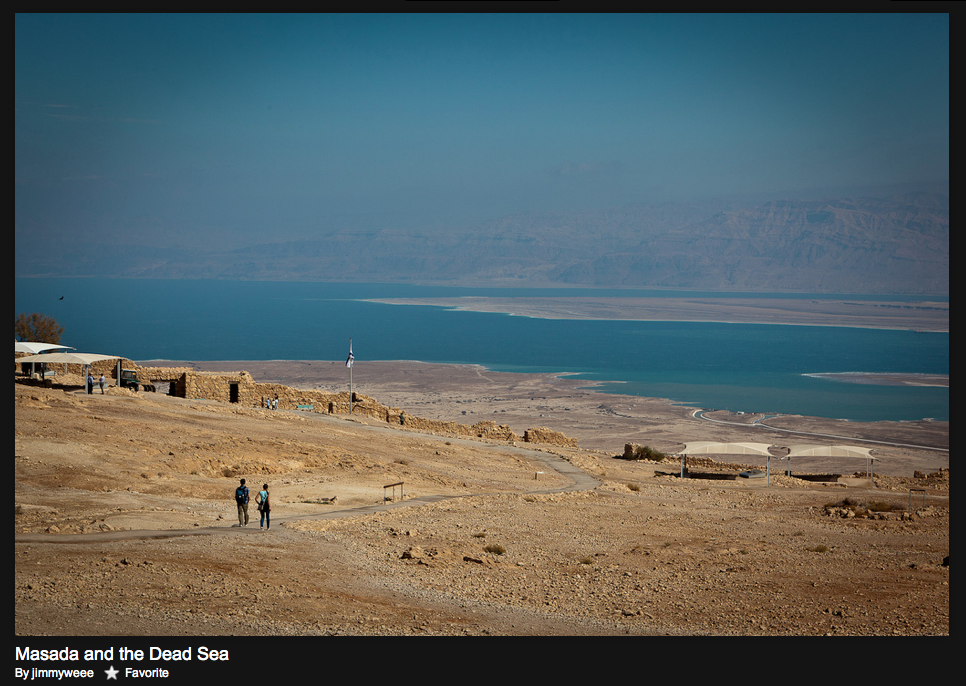
The Dead Sea - by Jimmyweee


Mt. Everest - by Phillip Milne

Why Teach?


After making the case that “it‘s all invented,” where “it” refers to our perception of reality, the Zanders invite us to re-define ourselves in the “University of Possibility.” Chapter 2 urges us to look beyond the confines of the “world of measurement” to stand “in the great space of possibility in a posture of openness, with an unfettered imagination for what can be.” Chapter 3 allows us the privilege of giving ourselves an “A.”  Release our selves from the imprisonment of measured standards. Become the self that you see earns that “A” grade.  This seems to be a great way to utilize the power of visualization, and improve ones ability to succeed.

At the age of 13 I traveled to Israel and visited The Dead Sea, the lowest point on the Earth’s surface.  After that experience, I saw a documentary about Sir Edmund Hillary’s ascent to the top of Mt. Everest, the highest point on the Earth’s surface. It became a goal of mine to get as close as possible to Mt. Everest, and I achieved this goal in 1987 when I trekked 350 miles through the country of Nepal, reaching the Mt. Everest expedition base camp, and then hiking up to the peak across from Mt. Everest known as Kala Pataar.  I had now witnessed the majesty of the mountain the Nepalese call Sagamartha (Mt. Everest) with my own eyes.

The Everest trek fulfilled my dreams of seeing the highest and lowest points on Earth.  Metaphysically, I had experienced the highs and lows of the Earth, and a great deal of the in-betweens as well.  When I returned home, I became depressed.  I felt (mistakingly) that there was nothing else to learn.  I don’t know why, but I pulled myself together with a single thought.  I had seen the highs and lows of life; it was to time to give back. It was time to contribute. It was time to teach.  Reading Chapter 4 of the Zander’s book brought this memory back to my life.

Wednesday, August 8, 2012

Wk 2: The Art of Possibility - Part 1


Sunset - UCSB by Vinay Shivakumar


Who Defines Your Vision of Beauty?


As an undergraduate at the University of California, Santa Barbara, I decided to take a Botany course about the native plants of California.  My attraction to the course was that it included two extensive four-day road trips through the California Wilderness. On one of these trips, I was assigned to be part of our instructor's group.  Her name was Kelly, and she was a PhD post-doc doing botanical research at UCSB. 


During one of our long drives (each group drove in their own University owned utility vehicle) we started conversing about relationships. Professor Kelly asked one of our female group members if she had a boyfriend.  The girl said “No” and Kelly asked “Why not?”  The girl replied, “I guess I’m not pretty enough.”  At that point, Kelly slammed on the brakes and pulled over.  She turned around, looked the girl deeply into her eyes, and told her, “Never accept a definition of beauty that does not include your self.” These words have been stuck in my head for nearly 30 years now.

For me, this is exactly what “The Art of Possibility” by Roz and Ben Zander is all about.  In the first Chapter, the Zander’s write, “It’s all invented anyway, so we might as well invent a story or a framework of meaning that enhances our quality of life and the lives of those around us.” In other words, if reality is merely an invented construct of the mind, we are continuously defining our reality either sub-consciously and/or consciously. We are much better off if we acknowledge this fact and begin a conscious effort to re-invent our own story in a way that promotes our own well-being, and thereby, each other’s well-being as well.  Take control, become aware, invent your own story, and define your own vision of beauty.

Sunday, August 5, 2012

Wk 1: Leadership Blog Post

It's hard to believe, but here we are in the final stage of our Action Research Project.  I remember reading about the "Publishing Leadership Project" requirement in Stage 3, and wondering what exactly that project was going to be.  Well, now we know!

For my Leadership Project, I am leaning towards "publishing an article" as opposed to "presenting at a conference."  I feel a little more confident in my writing skills than my multimedia presentation abilities; but for me, time is a major consideration.  In order to make a presentation at a conference, I would obviously need to attend that conference; and given my already way too busy schedule, it seems that it would be difficult for me to spend extra time away from home.  It does sound like a great experience to go and present, but I do not need to make travel arrangements to publish an article.  So as of now, I will be spending the next few days researching for appropriate publications to submit my AR Research Leadership project.

Good luck everyone!